Breast Cancer
Breast cancer is one of the most pressing public health challenges of our time. Worldwide, according to GLOBOCAN estimates from the International Agency for Research on Cancer (IARC), female breast cancer accounts for approximately 2.3 million new cases and over 666,000 deaths annually, ranking as the most frequently diagnosed cancer among women across 157 countries.
In Kenya it is-
The Leading Cancer in Kenya: Breast cancer is the most frequently diagnosed cancer in the country, accounting for 7,243 new cases each year, representing roughly 16.1% of all cancers and nearly one in every four (23.3%) cancers diagnosed in Kenyan women.
The Leading Cause of Cancer Mortality: With 3,119 deaths reported annually, breast cancer is the primary cause of cancer death among Kenyan women, carrying a lifetime risk where approximately 1 in every 24 women will develop the disease.
A Significantly Younger Demographic: In the west, breast cancer is predominantly postmenopausal, but in Kenya, the burden rises sharply between ages 35 and 49.
Between 70% and 75% of Kenyan patients are diagnosed only after the malignancy has already reached Stage III or Stage IV.
The diagnosis became painfully real for many people when Winnie Bwire Ndubi, a Kenyan Actress, publicly shared her battle with breast cancer.
Her openness brought attention to something that statistics often cannot communicate: breast cancer can happen to someone who appears young, healthy, successful and full of life and the diagnosis comes with enormous financial burden and emotional turmoil.
Her death in 2024 left behind more than grief. It left a reminder that breast cancer is not an abstract disease but it is happening and it does not ask for your age, profession, income, or public profile before it arrives.
Now, what exactly is breast cancer?
Breast cancer begins when cells within breast tissue acquire changes that cause them to grow and divide uncontrollably.
The breast contains glandular tissue made up of lobules, which produce milk, and ducts, which carry milk toward the nipple. Cancer can arise from these structures and, depending on its type and stage, may remain confined to the breast or invade surrounding tissue and spread to lymph nodes or distant organs.
But breast cancer is not one single disease.
Some cancers depend on hormones such as estrogen or progesterone to grow. Others overexpress a protein called HER2, which can drive rapid cell growth. Some, known as triple-negative breast cancers, lack estrogen receptors, progesterone receptors, and HER2.
This is the reason two people diagnosed with “breast cancer” may receive completely different treatments.
What should you look out for?
Many people think breast cancer always begins with a lump but it is not the only thing.
Look out for a new or persistent change in your breast, including:
A new lump or area of thickening
A change in breast size or shape
Skin dimpling or puckering
Skin that becomes thickened or develops an orange-peel appearance
A newly inverted or retracted nipple
Unusual nipple discharge, particularly bloody or spontaneous discharge
Persistent changes around the nipple or areola, such as crusting, redness, or ulceration
Swelling or a lump in the armpit
A persistent change in the appearance or texture of one breast
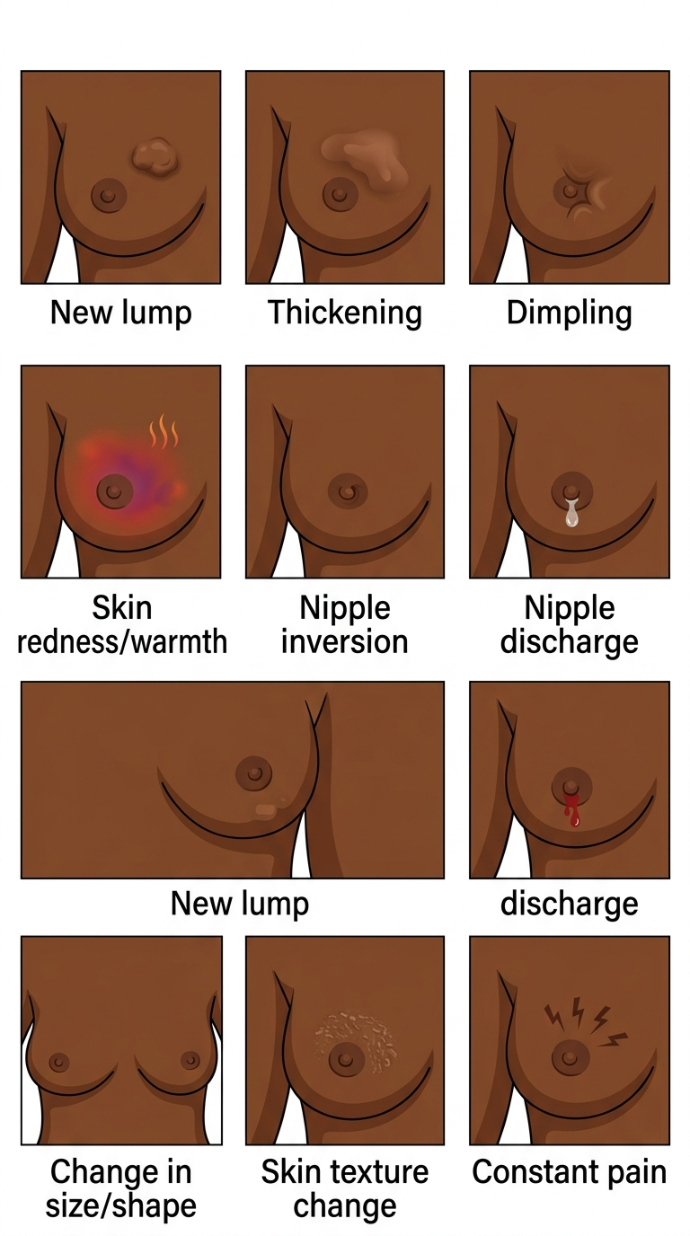
While many breast cancers are painless, a painful lump still requires assessment. At the same time, finding a lump does not mean you have cancer.
Many breast lumps are benign(non cancerous), including fibroadenomas, cysts, and can also be caused by hormonal changes.
Know your normal
For years, women were encouraged to perform rigid monthly breast self-examinations as a screening test.
Today, the emphasis is on breast self-awareness, knowing what your breasts normally look and feel like so that you can recognize a new change.
You can do this practically at home. Stand in front of a mirror and look at your breasts with your arms relaxed and then raised. Look for changes in shape, symmetry, skin, or nipple position.
You can also feel your breasts using the pads of your fingers, covering the entire breast from the collarbone downwards and from the breastbone across toward the armpit.
The goal is to create enough familiarity to notice an abnormality.
If you notice a new, persistent, or unusual change, do not wait for it to disappear and do not wait for your next menstrual cycle to seek help. Have it checked by a qualified healthcare professional.
Screening
Most breast cancer campaigns come along with breast cancer screening services and this is what it includes:
A clinical breast examination- a trained healthcare professional examining the breasts and nearby lymph nodes.
Ultrasound uses sound waves rather than radiation and can be particularly useful when evaluating a lump in younger women or when breast tissue is dense. It can also help differentiate solid lesions from fluid-filled cysts.
Mammography uses low-dose X-rays to look for abnormalities that may be too small to feel, including certain patterns of degenerative and architectural changes.
Importantly, women with or without symptoms are eligible for screening and a concerning change requires diagnostic assessment in addition to the screening.
What if breast cancer runs in your family?
Family history matters but it is not your fate.
Some breast cancers occur because of inherited genetic changes, including mutations involving genes such as BRCA1, BRCA2, and TP53.
You should pay particular attention to patterns such as:
A close relative diagnosed with breast cancer at a young age
Several relatives on the same side of the family with breast or ovarian cancer
Male breast cancer in the family
Close relatives developing cancer in both breasts
In such situations, genetic counselling may help determine whether genetic testing or an advanced screening strategy is appropriate.
But remember two important things:
Having a family history does not mean you will develop breast cancer.
Not having a family history does not mean you are protected.
Most women who develop breast cancer do not have a known family history of the disease. Knowing your family history simply allows you and your healthcare provider to understand your risk better.
And yes, men can get breast cancer
Breast cancer is overwhelmingly a disease of women, but it is not exclusively a woman's disease.
Men also have breast tissue and can develop breast cancer, although it is much less common and interestingly more aggressive as per the statistics. A man who develops breast changes already describe above should seek medical assessment. Remember those may not be pumped up pecs but (a) lump(s).
I found a lump. What happens next?
Doctors generally work through a process known as triple assessment:
1. Clinical assessment
A healthcare professional takes a history and examines the breast and surrounding lymph nodes.
2. Imaging
Depending on age, symptoms, and findings, this may involve ultrasound, mammography, or both.
3. Tissue diagnosis
If the lesion is suspicious, a biopsy may be performed. It establishes whether cancer is present and important features of the tumour, including hormone receptor and HER2 status.
A biopsy is what confirms cancer.
And no, a properly performed biopsy does not cause breast cancer to “spread throughout the body” - a common fear that can unfortunately lead people to delay diagnosis.
Breast cancer is not a death sentence
Treatment has changed dramatically.
Depending on the type and stage of the cancer, treatment may involve:
Surgery
Chemotherapy
Radiotherapy
Hormonal therapy
HER2-targeted therapy
Other targeted or immune-based treatments in selected patients
Some people undergo surgery first. Others receive chemotherapy or another systemic treatment before surgery to shrink the tumour.
Treatment decisions are made through multidisciplinary teams with the goal of treating the particular breast cancer that the individual patient has.
The myths that can cost time
If the lump hurts, it cannot be cancer.
Not necessarily. Pain does not rule out cancer.
A biopsy will make the cancer spread.
No. Core needle biopsy is a standard and important part of diagnosing suspicious breast lesions.
I should massage the lump first.
Massage should not be used as a substitute for medical assessment. It cannot determine what a lump is and may delay diagnosis.
Mammograms have too much radiation and could cause the cancer.
Mammography does involve radiation, but at a low dose. When appropriately recommended, its potential benefit in detecting breast cancer early outweighs the small radiation risk.
No one in my family has had breast cancer, so I am safe.
Not true. Family history can increase risk, but most breast cancers are not simply inherited from a known family mutation.
Where do you go in Kenya?
One of the biggest problems with telling people to “get screened” is failing to tell them where to go.
Major facilities such as Kenyatta National Hospital (KNH), Moi Teaching and Referral Hospital (MTRH), and Kenyatta University Teaching, Referral & Research Hospital (KUTRRH) provide oncology services, while other county and faith-based facilities provide various screening, diagnostic, and treatment services.
Organizations such as the Kenya Cancer Association, Faraja Cancer Support Trust, and Women 4 Cancer also provide education, support, outreach, or patient assistance.
Before going, however, confirm what services are actually being offered, whether an appointment is required, and what costs or insurance arrangements apply.
Now to sum it all up-
This month and every other month:
Know your normal.
Pay attention to how your breasts normally look and feel.
Know your family history.
Ask about breast, ovarian, prostate, and other cancers in your family.
Know your risk.
If you have a significant family history or other risk factors, discuss them with a healthcare professional.
Know when to seek help.
A new lump, nipple change, skin change, discharge, or persistent breast abnormality deserves assessment.
Know where to go.
Find out where breast examination, imaging, diagnosis, and treatment are available in your area.
And most importantly:
Do not wait because you are afraid of what the answer might be.
Early detection is not a slogan. For many people, it can mean the difference between finding a cancer when it is more treatable and discovering it only after it has advanced.
This October, let's do more than paint the atmosphere pink.
🎀
SOURCES
- National Cancer Control Program (NCCP), Ministry of Health, Kenya. (2021). National Cancer Screening and Early Diagnosis Guidelines. Nairobi: Ministry of Health, Republic of Kenya.
- National Cancer Control Program (NCCP), Ministry of Health, Kenya. (2020). Kenya National Cancer Specimen Handling Guidelines. Nairobi: Ministry of Health, Republic of Kenya.
- National Cancer Institute of Kenya (NCI-K). (2022). Status of Cancer in Kenya Report: Prevention, Screening, and Early Detection. Nairobi: Government of Kenya.
- World Health Organization (WHO) / International Agency for Research on Cancer (IARC). (2024). GLOBOCAN 2022: Cancer Today – Kenya Fact Sheet. Lyon: International Agency for Research on Cancer.
- Sayed, S., Ngugi, A. K., Mahoney, M. R., Kurji, J., Oyiro, P., Vinayak, S., & Moloo, Z. (2020). Breast Cancer Knowledge, Perceptions and Practices among Female Patients in Kenya: A Cross-Sectional Study. BMC Women's Health, 20(1), 1–11.
- Makau-Barasa, L. K., Greene, S. B., Othieno-Abinya, N. A., & Wheeler, S. B. (2018). A Review of Improving Access to Triple-Negative Breast Cancer Patient Care in Kenya. Journal of Global Oncology, 4, 1–11.
- Jedy-Agba, E., McCormack, V., Adebamowo, C., & dos-Santos-Silva, I. (2016). Stage at Diagnosis of Breast Cancer in Sub-Saharan Africa: A Systematic Review and Meta-analysis. The Lancet Global Health, 4(12), e923–e935.
- Gradishar, W. J., Moran, M. S., Abraham, J., et al. (2024). NCCN Clinical Practice Guidelines in Oncology: Breast Cancer (Version 2.2024). Fort Washington: National Comprehensive Cancer Network (NCCN).
- American Cancer Society (ACS). (2023). Breast Cancer Facts & Figures 2023–2024. Atlanta: American Cancer Society, Inc.